
If you are shopping for a flight school on Long Island, you will quickly run into a wall of terminology: Part 61, Part 141, VA-approved, R-ATP, accredited, certified. Schools use these terms in their marketing, and some of them carry real weight while others are decorative. Understanding the difference matters because it affects your training timeline, your cost, your eligibility for benefits, and the quality of the instruction you receive. Here is a clear breakdown of what each label means, what it does not mean, and what you should actually look for when you walk into a school at KFRG.
Part 61 vs Part 141: the fundamental distinction
The most important distinction in flight training is between FAR Part 61 and FAR Part 141. These are two sets of Federal Aviation Regulations that govern how flight training is conducted, and they differ in structure, not in the certificate you earn. A private pilot certificate earned under Part 61 is the exact same certificate as one earned under Part 141 — the plastic card the FAA issues does not say which regulation you trained under. The difference is in how the training is organized and what minimums apply.
Part 61 is the more flexible path. It is what most flight schools on Long Island use, and it is what Aspire Aviation operates under. Under Part 61, the PPL requires a minimum of 40 flight hours (though the national average is closer to 60 to 70 hours), and the training is student-paced: you and your CFI schedule lessons as you go, and the curriculum adapts to your progress. There is no required syllabus, no stage checks, and no strict timeline. The flexibility is the advantage — you can fly around your work schedule, take breaks when life gets busy, and progress at your own speed. The downside is that without structure, it is easier to lose momentum, and the lack of a formal syllabus means the quality of your training depends heavily on the individual instructor.
Part 141 is the more structured path. Schools operating under Part 141 must have an FAA-approved training syllabus, standardized stage checks, and a Chief Pilot who oversees the program. The PPL minimum under Part 141 is 35 flight hours — lower than Part 61's 40 — because the structured curriculum is designed to be more efficient. Part 141 schools are subject to regular FAA inspections and must maintain specific standards to keep their certificate. The trade-off is rigidity: you follow the syllabus in order, you meet stage-check requirements on schedule, and the program is less forgiving of interruptions. For students who want structure and who plan to fly a career track, Part 141 can be the right fit. For students who need flexibility, Part 61 is usually better.
If you want a deeper comparison, we have a full post on Part 61 vs Part 141 flight training that goes into more detail on the differences, the minimums, and how to choose.
What accreditation means — and does not mean
Accreditation is a term that gets thrown around loosely in flight school marketing, but it has specific meanings. The FAA does not accredit flight schools in the way a university is accredited. What the FAA does is certify schools under Part 141 — that is a certification, not an accreditation. Accreditation in the academic sense comes from bodies like the Accrediting Commission of Career Schools and Colleges (ACCSC) or similar regional accreditors, and it is typically held by larger aviation universities or academy-style programs. A Part 141 certificate is not accreditation, and an accredited school is not necessarily better than a non-accredited one — it depends on what you need.
What accreditation does provide is eligibility for federal financial aid — Pell Grants, federal student loans, and in some cases VA benefits under the GI Bill. If you are using federal aid or VA benefits to fund your training, you need a school that is both Part 141 and accredited by a recognized body. If you are paying out of pocket or using private financing, accreditation does not matter to you. The quality of instruction at a non-accredited Part 61 school can be just as good — or better — than at an accredited Part 141 school, because quality comes from the instructors and the culture, not from the label on the wall.
VA and GI Bill considerations
If you are a veteran planning to use GI Bill benefits for flight training, the requirements are specific. The school must be Part 141-approved by the FAA, and it must be approved by the state's approving agency for VA education benefits. The GI Bill does not cover Part 61 training. Under the Post-9/11 GI Bill, you can receive reimbursement for flight training at a Part 141 school, but you must already hold a private pilot certificate — the GI Bill covers training from the instrument rating onward, not the PPL. Under some chapters (Chapter 33, Chapter 31), the rules differ, and the monthly housing allowance and fee structure can be complex.
For veterans on Long Island, the practical question is whether there is a Part 141 school nearby that is VA-approved, and whether the timeline and structure of a Part 141 program fit your needs. Not every Part 141 school is VA-approved, and not every VA-approved school is close to you. At Aspire, we operate under Part 61, so we are not the right fit for someone who needs GI Bill funding — but we are honest about that, and we would rather tell you upfront than have you find out halfway through a conversation. If VA funding is essential to your plan, we can point you toward schools in the Long Island and NYC area that do qualify.
R-ATP eligibility: the restricted ATP
If you are on a career track toward the airlines, R-ATP (Restricted-Authority Airline Transport Pilot) eligibility is a term you need to know. A standard ATP certificate requires 1,500 hours of total flight time. Under FAR Part 61.160, certain pilots can qualify for a restricted ATP with fewer hours: 1,000 hours if you graduated from a four-year aviation degree program at a Part 141 school, or 1,250 hours if you graduated from a two-year program. The military path has its own hour requirements. The R-ATP allows you to serve as a first officer at 21 instead of 23, with the reduced hour requirement.
R-ATP eligibility is tied to the school and the program, not just to you. If you train at a Part 141 school with an approved R-ATP curriculum and graduate from that program, you may qualify for the 1,000 or 1,250-hour reduced minimum. If you train Part 61, you are on the 1,500-hour path regardless of how good your training was. For pilots on the airline track who want the reduced hour requirement, Part 141 is the only route. For pilots who are willing to build the full 1,500 hours — through instructing, banner towing, or other time-building jobs — Part 61 is fine, and the certificate you earn is identical. The question is whether the time savings of R-ATP is worth the structure and cost of a Part 141 program.
Why the instructors matter more than the label
Here is the truth that the marketing does not tell you: the label on a flight school — Part 61, Part 141, accredited, VA-approved — tells you almost nothing about the quality of the instruction. A Part 141 school with a rigid syllabus and indifferent instructors will produce a worse pilot than a Part 61 school with engaged CFIs who care about your progress. The certificate you earn is the same either way. What differs is the experience, the mentorship, and the habits you develop along the way.
At Aspire, we operate under Part 61, and we have made a deliberate choice to focus on the quality of instruction rather than the label. Our instructors are the core of what we do — the training team model at Aspire pairs each student with a primary CFI and ensures a smooth handoff if your primary instructor changes. A Chief Pilot oversees the standard, and the culture is one of mentorship, not throughput. That matters more than any certificate on the wall. When you visit a school at KFRG or anywhere on Long Island, look past the website language and ask to meet the instructors. Ask about their backgrounds, how long they have been teaching, how they structure lessons, and whether you would feel comfortable flying with them twice a week for months.
What to actually look for when visiting a school at KFRG
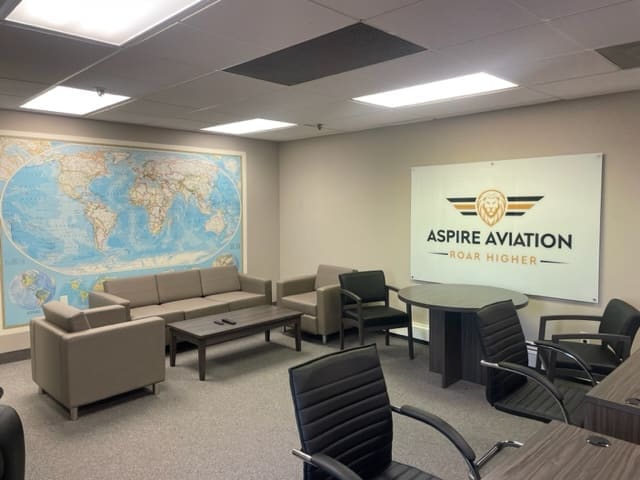
If you are visiting flight schools at Republic Airport, here is a practical checklist that matters more than the accreditation labels. First, look at the aircraft. Are they clean, well-maintained, and equipped with the avionics you want to train in? At Aspire, our fleet is six Cessna 172s, five with Garmin glass panels — the kind of equipment you will actually use as a pilot, not just as a student. Second, talk to the instructors. Are they engaged, patient, and willing to answer questions without pressure? Do they seem like people you could learn from for months? Third, ask about scheduling and availability. Can you book lessons easily? Is there a booking system or app? Fourth, talk to current students if you can — ask them about their experience, their progress, and whether they feel supported. Fifth, look at the facility. Is it a real operation with a classroom, a simulator, a briefing area, or is it a corner of a hangar? The facility tells you about the school's investment in the student experience.
Sixth — and this is the one most people skip — ask about the school's culture around safety and standards. What happens when a student is struggling? How does the school handle weather cancellations and make-up lessons? What is the policy on instructor changes? The answers tell you whether the school treats students as customers to be processed or as pilots to be developed. At Aspire, we are at 1100 New Highway in Farmingdale, on the south side of KFRG, and we welcome prospective students to visit, meet instructors, see the aircraft, and ask questions before committing to anything. The best school for you is the one that feels right when you walk in — not the one with the most labels on the website.
Read about Part 61 vs Part 141 →, learn about our Long Island flight school →, or explore training programs →