
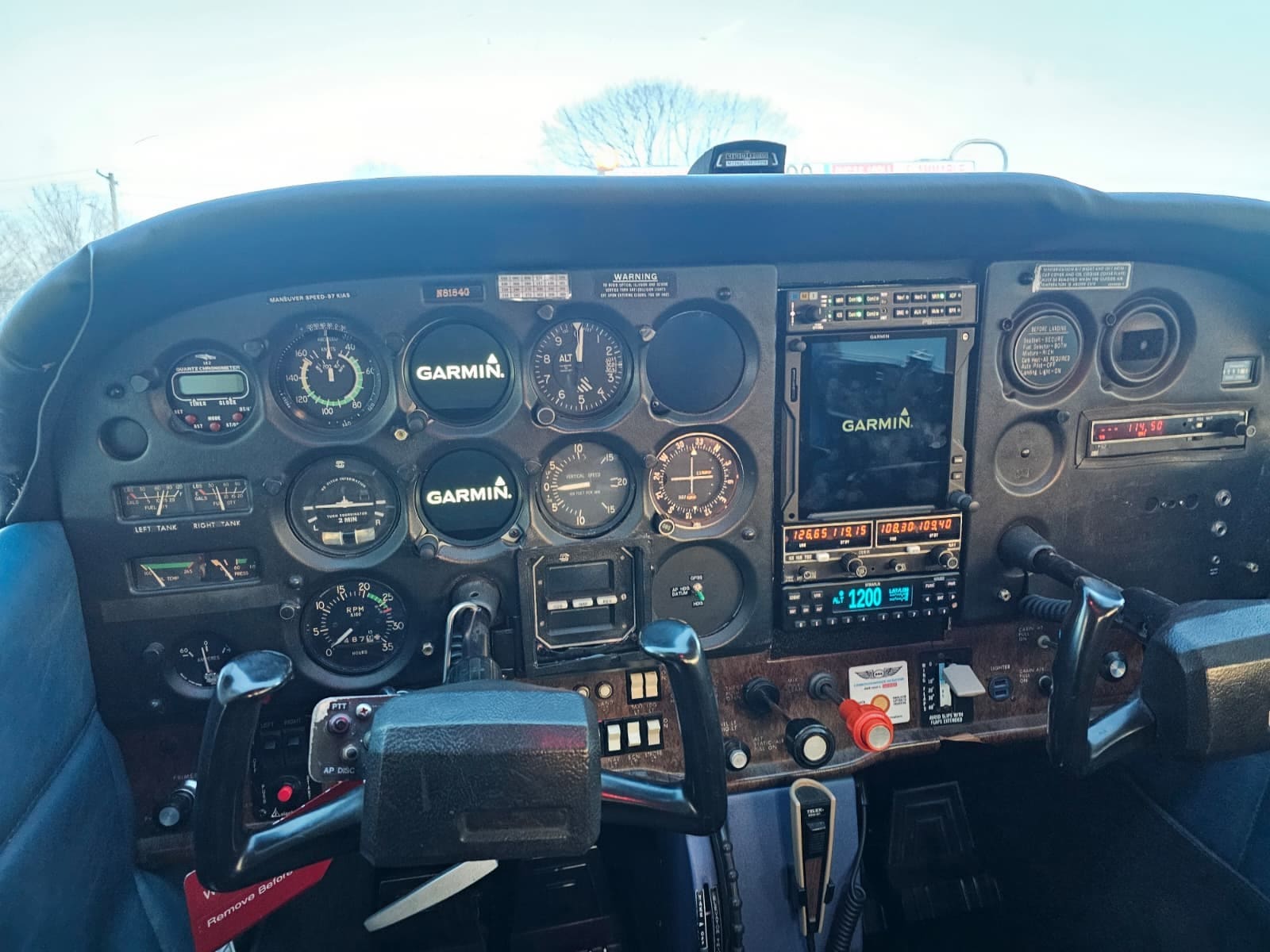
The instrument rating is the natural next step after the private pilot certificate, and it is the rating that most changes what you can actually do with a pilot's license on Long Island. Without it, you are limited to visual flight rules — clear skies, visible horizon, no clouds. With it, you can file IFR flight plans, fly through instrument conditions, and depart KFRG on a gray morning when the ceiling is 400 feet. But the timing of when to start that training is a real decision, and it is worth thinking through before you commit.
Right after PPL: the momentum argument
The case for starting instrument training immediately after your PPL checkride is simple: momentum. You are in the habit of flying regularly, you are current on radio calls and airspace procedures at KFRG, and your study habits are still sharp. The jump from VFR to IFR is significant, but it is easier when you have not had time to get rusty. Students who take a break after the PPL often find it harder to restart — they lose currency, their landings get sloppy, and they spend the first few IR lessons relearning basics they had mastered. If you are flying two or three times a week post-checkride, starting instrument training while that rhythm is alive is the path of least resistance. At Aspire, we see students who go straight from PPL to IR finish the instrument rating faster and with fewer total hours than those who take a gap.
There is a practical reason too: on Long Island, the weather will force the question sooner than you think. The Northeast gets low ceilings, haze, and marine layers off the Sound with regularity. The first time you drive to KFRG for a VFR flight and see the ceiling at 800 feet, you will understand why the instrument rating is not a luxury here — it is a utility. Starting it right after your PPL means you are working toward that capability while the motivation is fresh.
After building time: the currency argument
The other approach is to build cross-country time first, then start the IR. Under FAR Part 61, the instrument rating requires 50 hours of cross-country flight time as pilot in command before the rating can be issued. That is a separate requirement from the instrument instruction itself — the 50 hours is PIC cross-country time, not dual IR training time. For students who earned their PPL with the bare minimum of cross-country flying, that 50-hour requirement can be a significant additional cost and time commitment. If you build those hours first — flying VFR cross-countries from KFRG to airports across Long Island, Connecticut, and New Jersey — you arrive at instrument training with the cross-country requirement largely met, and your IR training becomes purely about the instrument skills, not hour-building.
The trade-off is that building those 50 hours on your own, without an instructor, means you are VFR-only the whole time, and you may develop habits that need correcting once you start IR work. Some pilots enjoy this phase — they use the time to explore the Northeast, visit new airports, and get comfortable with navigation before adding the cognitive load of instrument procedures. Others find it tedious and want to get straight to the rating. There is no wrong answer, but there is a planning answer: know where you stand on the 50-hour requirement before you start IR training so it does not become a bottleneck late in the process.
What the 50 hours of XC PIC actually means
Let's break this down because it confuses a lot of pilots. Under Part 61, to earn an instrument rating you need: a private pilot certificate, 50 hours of cross-country flight time as PIC (pilot in command), 40 hours of instrument flight time (actual or simulated), and a passing score on the instrument written exam and checkride. The 50 hours of cross-country PIC is time you log yourself as PIC on flights that meet the cross-country definition — a flight to an airport more than 50 nautical miles from your departure point. This is separate from the 40 hours of instrument training. You can build those 50 hours during your PPL training (your long cross-country counts), during post-PPL VFR flying, or concurrently with your IR training. The key is that it must be PIC time — you are the one logging the flight, not a CFI.
At Aspire, we help students plan this from the start. If you know the IR is in your future during PPL training, we structure your cross-country flights to build toward the 50-hour requirement efficiently. From KFRG, cross-country destinations that count include airports like Hartford-Brainard (KHFD), Groton-New London (KGON), Montauk (MTP), and Danbury (DXR) — all more than 50 NM from Republic Airport and all within a reasonable training flight. Building those hours over Long Island and the surrounding states is genuinely enjoyable flying, and it makes you a better pilot before you ever put a view-limiting device on.
How Aspire structures IR training at KFRG
Instrument training at Aspire Aviation is built around the Cessna 172 with Garmin glass panels — five of our six 172s have the avionics you need for serious IFR work. Training happens at Republic Airport (KFRG), a Class D towered field, which means you are learning instrument procedures in real controlled airspace from day one. You will work with a CFII (certified flight instructor — instrument) on attitude flying by reference to instruments, holding patterns, intercepting and tracking VORs and GPS courses, and flying instrument approaches — ILS, RNAV (GPS), VOR, and circling approaches to the runways at KFRG and surrounding fields. The structure follows the FAR Part 61 requirements: 40 hours of instrument time (up to 20 can be in our Gleim simulator, an FAA-approved Basic Aviation Training Device), the written exam, and the checkride with a DPE.
We also use the simulator heavily. The Gleim BATD at Aspire lets you practice approaches, holdings, and procedures without the cost and weather dependency of the aircraft. It is a realistic representation of a glass-cockpit Cessna 172, and time in it counts toward your IR requirements under Part 61. For students on Long Island, where actual instrument conditions are not hard to find, the simulator is where you build the procedural foundation, and the aircraft is where you apply it in real weather. That combination — simulator for procedure, aircraft for execution — is how we keep IR training efficient and cost-effective.
NYC airspace considerations for IFR
Training at KFRG puts you in one of the busiest airspace environments in the country. Republic Airport sits under the New York Class B shelf, with JFK, LaGuardia, and Newark all within 25 miles. When you file IFR from KFRG, you are entering a system that manages some of the highest-density traffic in the United States. That is a real advantage for your training: you learn to fly IFR in the environment you will actually operate in. You talk to New York Approach, you get routings through the Class B, you deal with the real volume and the real expectations ATC has of instrument-rated pilots. Students who train at quiet rural fields and then try to fly IFR in the Northeast face a learning curve that KFRG students have already handled.
There are practical considerations too. IFR clearances from KFRG often involve vectors that take you north over Long Island Sound or south toward the Class B boundary, depending on your route. Departures can be to the northeast, where the JFK arrival flows are, or to the west, where you navigate between the Newark and LaGuardie approach corridors. Learning to manage these routings while flying on instruments is part of what makes IR training at Republic Airport genuinely valuable — you are not just learning to fly by reference to instruments, you are learning to fly by reference to instruments in the airspace you will use for real.
So when should you start?
If you are career-oriented — headed toward a CPL, CFI, and eventually ATPL — start as soon as you reasonably can after your PPL. The instrument rating is a prerequisite for the commercial certificate, and every month you delay is a month added to your timeline. If you are a hobbyist who flies on weekends and wants the safety margin of being able to handle inadvertent IMC, the timing is more flexible, but the Northeast weather will eventually make the case for you. Our recommendation for most students on Long Island: start IR training within three to six months of earning your PPL. That is close enough to keep your skills sharp, but gives you time to build some cross-country PIC hours and enjoy the PPL before you put the view-limiting device on. If you already have the 50 hours of XC PIC, start as soon as you are ready — there is no reason to wait.
Read our full instrument rating explainer →, explore our instrument program →, or contact Aspire →