
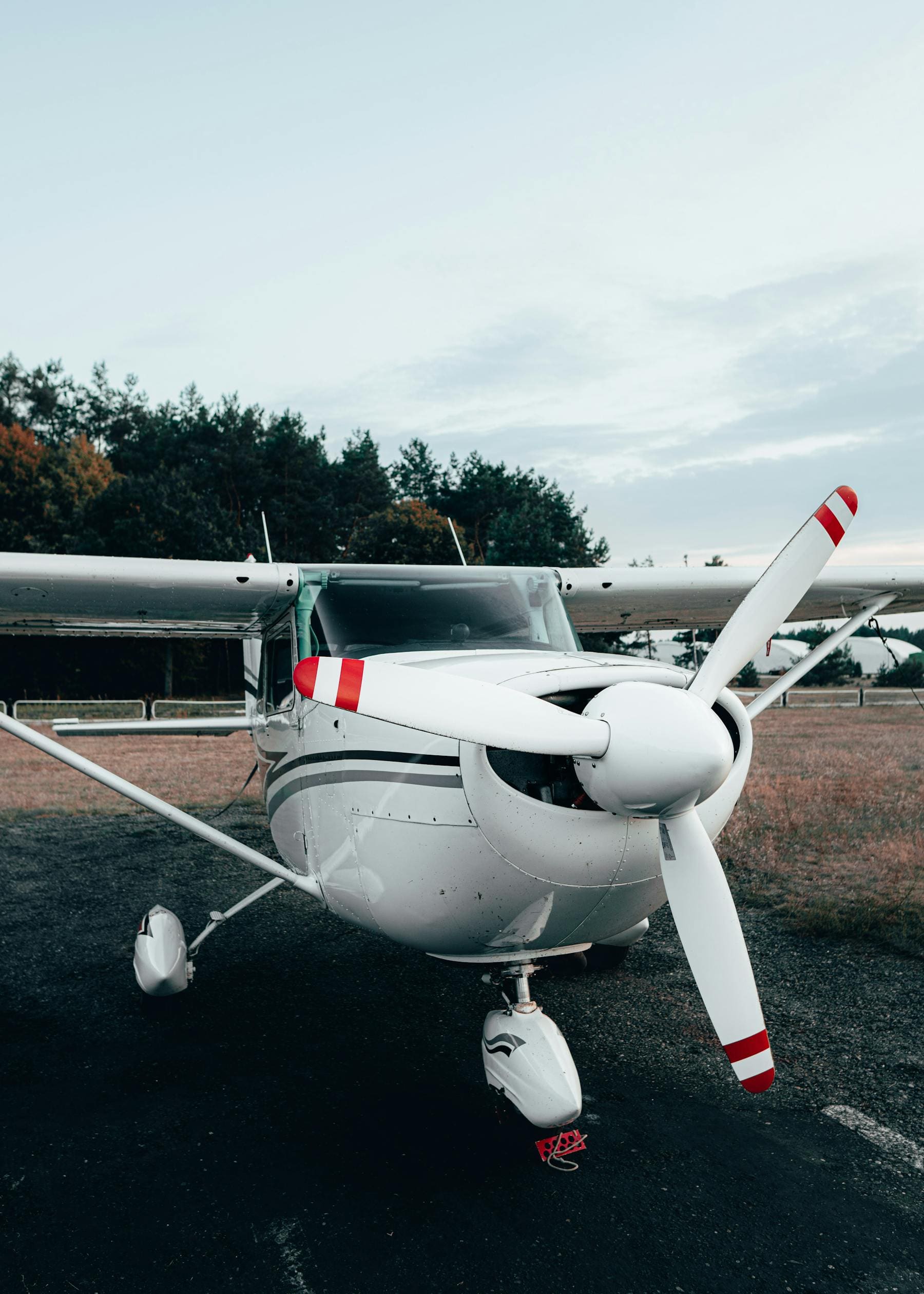
The Cessna 152 and the Cessna 172 are the two most common training aircraft in general aviation, and if you are training at any flight school on Long Island — Aspire Aviation included — you are going to spend time in one or both. At Aspire, we fly Cessna 172s exclusively, and there is a reason for that. But to understand why the 172 has become the default trainer at KFRG and across the country, it helps to understand what each airplane is, where they differ, and what those differences mean for you day to day in the pattern at Republic Airport.
The Cessna 152: the lightweight trainer
The Cessna 152 is a two-seat, single-engine trainer with a 110-horsepower Lycoming O-235 engine. It was produced from 1977 through the mid-1980s as a replacement for the older Cessna 150, and it was designed from the ground up as a no-frills primary trainer. Its biggest advantage is cost: the 152 burns less fuel per hour than a 172, and because it is a lighter, simpler aircraft, hourly rental rates are typically lower. For a student working through the private pilot certificate (PPL) under FAR Part 61 or Part 141, those savings add up over 40 or 50 hours of training. The 152 is also genuinely fun to fly — it is light on the controls, responsive, and you feel every bump of thermals over the Long Island shoreline, which builds a real feel for the air.
The catch is weight and capacity. The 152 has a maximum useful load of roughly 1,670 pounds, but with full fuel that leaves around 500 to 550 pounds for people and baggage. Two adults and you are often at or near the limit, especially in summer when density altitude at KFRG reduces performance. If you and your CFI are both on the taller or heavier side, the 152 can feel cramped and the performance margins shrink on a hot day departing Republic Airport. For solo flight training — pattern work, stalls, slow flight, short-field landings on Runway 14/32 or 1/19 — the 152 is perfectly adequate. But it limits what you can do with the airplane once you have your certificate.
The Cessna 172: the four-seat standard
The Cessna 172 Skyhawk is a four-seat, single-engine aircraft with a 160-horsepower (or, in later models, 180-horsepower) Lycoming engine. It has been in continuous production longer than any other aircraft in history, and it is the most-produced aircraft in general aviation. At Aspire Aviation, our fleet is six Cessna 172s — five equipped with Garmin glass panels — and they are the aircraft our students fly from day one through commercial and CFI/CFII training. The 172 is heavier, faster, and more capable than the 152 in every dimension. It carries four people with reasonable fuel, climbs better, handles crosswind components at KFRG with more authority, and gives you a platform you will not outgrow.
The trade-off is cost: the 172 typically rents for more per hour than a 152, and it burns more fuel. But that extra cost buys capability. Once you have your PPL, the 172 lets you take three friends to Martha's Vineyard or Block Island for the weekend — a realistic mission you simply cannot do in a 152. For instrument training under IFR, the 172's heavier panel, Garmin avionics, and more stable platform make it the natural trainer, and that is what you will fly for the instrument rating (IR) at Aspire. For the commercial certificate (CPL), the 172 is the aircraft you will use for the complex maneuvers and the long cross-countries the FAA requires. The 152, by contrast, is largely done serving you once you have a PPL.
Weight and capacity: the practical difference
The most practical difference between the two aircraft is useful load — what you can put in the airplane before you hit its maximum gross weight. The 172 has a useful load of roughly 800 to 900 pounds with full fuel, compared to the 152's 500-ish pounds. That means in a 172 you can carry a full load of passengers and bags and still have range. In a 152, you are doing weight and balance math before every flight with two people aboard, and some combinations simply do not work. On Long Island, where summer temperatures push density altitude up and reduce climb performance, the 172's extra horsepower is a real safety margin departing KFRG's 5,000-foot runways with a CFI and a student aboard. The 152 can do it, but the margins are tighter and the performance is more marginal on a 90-degree day.
This matters for cross-country training too. Under Part 61, the PPL requires a long cross-country of 150 nautical miles with full-stop landings at three airports. From KFRG, that might mean Republic to Hartford to Montauk and back — a route that takes you through the busy Class D and Class C airspace around Long Island Sound. In a 172, that is a comfortable afternoon flight. In a 152, it is doable but slower, and you are more limited in where you can stop and what you can carry. The 172 simply opens up more of the Northeast as realistic training territory.
Cost: the honest math
The Cessna 152 is cheaper to operate per hour — often meaningfully so. If you are training under Part 61, which requires a minimum of 40 hours for the PPL (most students on Long Island finish closer to 55 to 70 hours), saving $20 to $30 per hour on the aircraft adds up. But the cost calculation is not just about the hourly rate. The 172 prepares you for everything that comes after the PPL: instrument training, commercial, CFI. If you plan to continue, every hour in the 172 is building time in the aircraft you will use for the rest of your training, while hours in the 152 are largely specific to the PPL. For career-minded students at Aspire, starting in the 172 from day one means no transition later. For a hobbyist who only wants a PPL and is cost-sensitive, the 152 can make sense if it is available — but fewer and fewer schools on Long Island maintain 152s in their fleet, and Aspire does not.
Which certificate suits which aircraft
For the private pilot certificate, both aircraft work. The FAA does not care which trainer you used — the PPL requirements under FAR Part 61 are the same regardless of airframe. You can do all your VFR training, your solo, your cross-countries, and your checkride in either. For the instrument rating, the 172 is the standard: you need a panel with the right avionics, and the 172's stability and equipment suit IFR training better. For the commercial certificate, the 172 is what you will fly — the CPL requires complex aircraft time, and while a 152 can be used for some commercial maneuvers, the 172 is the practical choice. For CFI and CFII certification, you will be teaching in the 172. In short: the 152 is a PPL trainer, the 172 is a career trainer.
Why Aspire flies 172s
At Aspire Aviation, our fleet is six Cessna 172s, five of them equipped with Garmin glass cockpits. We made that choice deliberately. Every student who trains with us — from the discovery flight through the CFI — flies the same airframe, which means no transition training, no switching between cockpit layouts, and no lost time moving from a 152 to a 172 when you start instrument work. You learn the 172's systems, its performance numbers, and its Garmin panel, and that knowledge carries straight through from your PPL to your CPL. Training at Republic Airport (KFRG), a busy Class D towered field, the 172's performance margins also give students more room to focus on radio calls, traffic avoidance, and airspace management without worrying about whether the airplane can handle the load. That matters at KFRG, where you are sharing the pattern with everything from light sport aircraft to corporate jets and the traffic pattern can get busy.
Which one should you choose
If your goal is a private pilot certificate and nothing else, and you can find a 152 at a school you trust, it will save you money on the PPL and the airplane is perfectly capable for VFR flight training. If your goal goes beyond the PPL — instrument, commercial, CFI, or a career path toward ATPL — the 172 is the aircraft you should be in from the start. You will pay more per hour, but every hour builds toward what comes next, and you avoid a transition. At Aspire, we only fly 172s, so that is the aircraft you will learn in if you train with us at KFRG on Long Island. Either way, the airplane matters less than the training itself — a good CFI in a 152 will make you a better pilot than a mediocre one in a 172. The aircraft is the tool; the instruction is what counts.
Learn more about our training programs →, read about how long the PPL takes →, or talk to Aspire →