
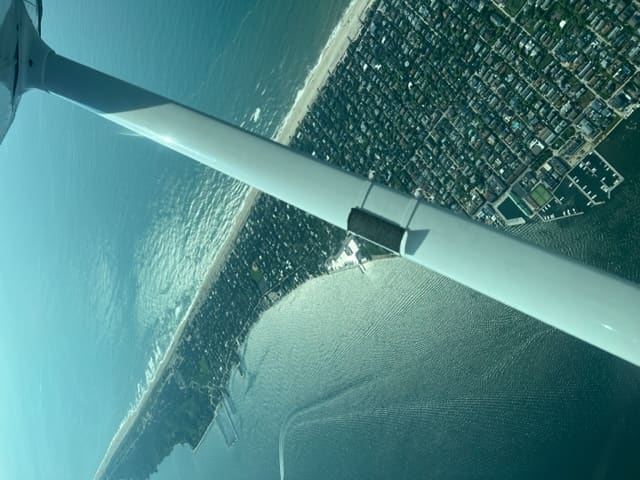
Night flying is one of the most rewarding things you can do as a VFR pilot on Long Island, and it is also one of the most humbling. Everything you learned during the day still applies, but the visual references change, the cockpit feels different, and the margin for error narrows. For pilots training at Republic Airport (KFRG), night flying is also a required part of the private pilot certificate — you need night training and solo night time to earn your PPL under Part 61. Whether you are a student working through your night requirements or a rated pilot thinking about a sunset flight to Montauk, here is what you need to know about flying VFR at night on Long Island.
What looks different at night
The most immediate change is the horizon. During the day, the natural horizon is your primary attitude reference — the line where the sky meets the ground or the Sound. At night, that horizon may disappear entirely. Over the interior of Long Island, the horizon becomes a faint glow of distant town lights, and over the ocean south of the barrier beaches, it vanishes altogether. Your eyes adjust, but they adjust differently than they do in daylight. Night vision relies on rod cells in the retina, which are more sensitive but less precise and slower to adapt. It takes 20 to 30 minutes for your eyes to fully dark-adapt, and a single flash of bright light — a landing light, a cockpit light left on, the headlights of a car on Route 110 — can reset that adaptation back to zero. Pilots learn to use off-center viewing, scanning by looking slightly to the side of an object rather than directly at it, because the center of your retina has fewer rod cells. None of this is theoretical — it is what you experience the first time you fly over Farmingdale after sunset.
Depth perception changes too. During the day, you judge distance to the runway by visual cues — texture, relative size, motion parallax. At night, those cues are weaker. A runway lit by edge lights can look farther away or closer than it is, and the tendency is to fly a lower-than-normal approach because the lights make you feel higher than you actually are. This is a well-known night-flying hazard, and it is why instructors at Aspire emphasize stable, instrument-assisted approaches at KFRG at night — use the altimeter and the VASI or PAPI lights on Runway 14/32, do not trust your eyes alone.
The regulatory requirements for night flying with passengers
Under FAR 61.57(b), to carry passengers at night you must have made at least three takeoffs and three landings to a full stop within the preceding 90 days, between one hour after sunset and one hour before sunrise, in the same category and class of aircraft. Those landings must be full stop — not touch-and-goes — because night operations demand more deliberate handling. If you do not meet this currency, you cannot legally carry passengers at night, period. You can still fly solo at night with a current medical and PPL, but carrying friends or family requires the three full-stop landings within 90 days.
For the PPL itself, FAR Part 61.109 requires at least 3 hours of night flight training, including 10 takeoffs and 10 landings to a full stop, and one cross-country flight of more than 100 nautical miles total distance. At Aspire, that night training is built into the PPL syllabus — you will fly with your CFI from KFRG after sunset, practice night pattern work, and do the required night cross-country, typically to an airport in Suffolk County and back. For students who plan to add the night tailwheel or other endorsements later, the night PPL requirements are the foundation.
What the NYC skyline looks like from the air at night
This is the part most people are curious about, and it does not disappoint. Flying VFR at night over Long Island, with the Manhattan skyline to your west, is one of the most striking views in general aviation. From KFRG, on a clear night you can see the lights of Brooklyn and Queens stretching westward, the Manhattan bridge spans lit up, and the Hudson River corridor marking the edge of the city. To the north, the lights of Nassau County run in a grid from the Sound shore inland, and to the east, Suffolk County opens up — denser near the main roads, sparser toward the Pine Barrens and the East End. On a dark night over the water south of Long Island — the Great South Bay or the Atlantic off the barrier beaches — the blackness below is absolute, a real reminder of how different night flying is from daytime.
If you are night-current and comfortable, a flight from Republic Airport westward along the Long Island shoreline, keeping the coast in sight, is a memorable experience. The key is planning: know your route, understand the airspace (the New York Class B shelf sits above KFRG and extends westward), and file a VFR flight plan or at least let someone know where you are going. Night flying over the Northeast without a flight plan is legal but not always wise — if something goes wrong, you want someone to know where to look.
Landing at KFRG at night
Republic Airport (KFRG) has two runways: 14/32 and 1/19, both lit with medium-intensity runway edge lights and threshold lights. The tower at KFRG operates during the day and typically closes in the evening — when the tower is closed, the airport becomes uncontrolled and you announce your intentions on the common traffic advisory frequency (CTAF). That means night landings at KFRG are often without tower services, which adds a layer of self- coordination. You need to listen for other traffic, announce your position in the pattern, and be especially vigilant — other pilots may be operating without the tower sequencing them. Runway 14/32 is the primary runway at KFRG, 5,000 feet long, and it has a VASI (visual approach slope indicator) to help you stay on glide path at night. Use it. The PAPI on Runway 14 is your best friend when your eyes are telling you conflicting things about your height.
Taxiing at night deserves attention too. The taxiway lights at KFRG are blue edge lights and reflectors, but the ramp and parking areas can be poorly lit in places. Move slowly, use your taxi light, and have a taxi diagram handy. The last thing you want at night is a runway incursion because you could not see the hold short markings. After shutdown, a flashlight is useful for the walkaround and for finding your way from the ramp to the FBO. Aspire's ramp at 1100 New Highway is on the south side of the field, and navigating it at night is straightforward if you are familiar with the layout — but if it is your first time, take it slow.
When night cross-country makes sense
Night cross-country flying on Long Island is a judgment call. On a clear, moonlit night with good visibility, a VFR cross-country from KFRG to an airport in Suffolk County — say, to East Hampton or Montauk — is a reasonable, enjoyable flight. The lights of Long Island provide navigation reference, the air is usually smoother at night, and the frequency congestion that plagues the Northeast during the day tends to quiet down. On a dark night with no moon, over the Pine Barrens or the ocean, the lack of visual reference is genuinely disorienting, and that is a flight to think carefully about. For the PPL night cross-country requirement, your CFI at Aspire will plan the route with you, choosing destinations that are well-lit and within comfortable distance of KFRG.
If you have an instrument rating, night cross-country is safer because you can fly IFR and rely on ATC and your instruments rather than visual reference alone. But even VFR-only, a night cross-country over Long Island is doable with proper planning: pick a clear night, file a VFR flight plan, carry a flashlight, and choose airports with good lighting and familiar approaches. And if the weather is marginal, the moon is not up, or you are not night-current — stay on the ground. Night flying has less margin than day flying, and the honest answer is that most night flights are optional. The ones that are worth doing are the ones you planned for, not the ones you rushed into.
Practical tips for night flying from KFRG
Carry two flashlights — a red one for the cockpit (to preserve your night vision) and a white one for the walkaround and ground operations. Dim the cockpit lights as low as you can while still reading the instruments. On the Garmin panels in Aspire's 172s, the screen brightness can be reduced significantly, and doing so keeps your eyes dark-adapted. Plan your route before you start the engine — heads-down chart work at night with a bright iPad screen will reset your night vision. If you are flying with passengers, brief them on what to expect, and remember that the full-stop landing requirement for night currency is there for a reason: night landings are less forgiving, and you want every one of them to be deliberate.
Learn more about training programs →, read about training at a towered airport →, or talk to Aspire →