We are one of the flight schools at Republic Airport, so read this with that in mind — but we will be fair, because the honest answer is that KFRG has several good options and the right one depends on your goals, your budget, and your schedule. What follows is what we would tell a friend asking where to train.
Why Republic Airport works for training
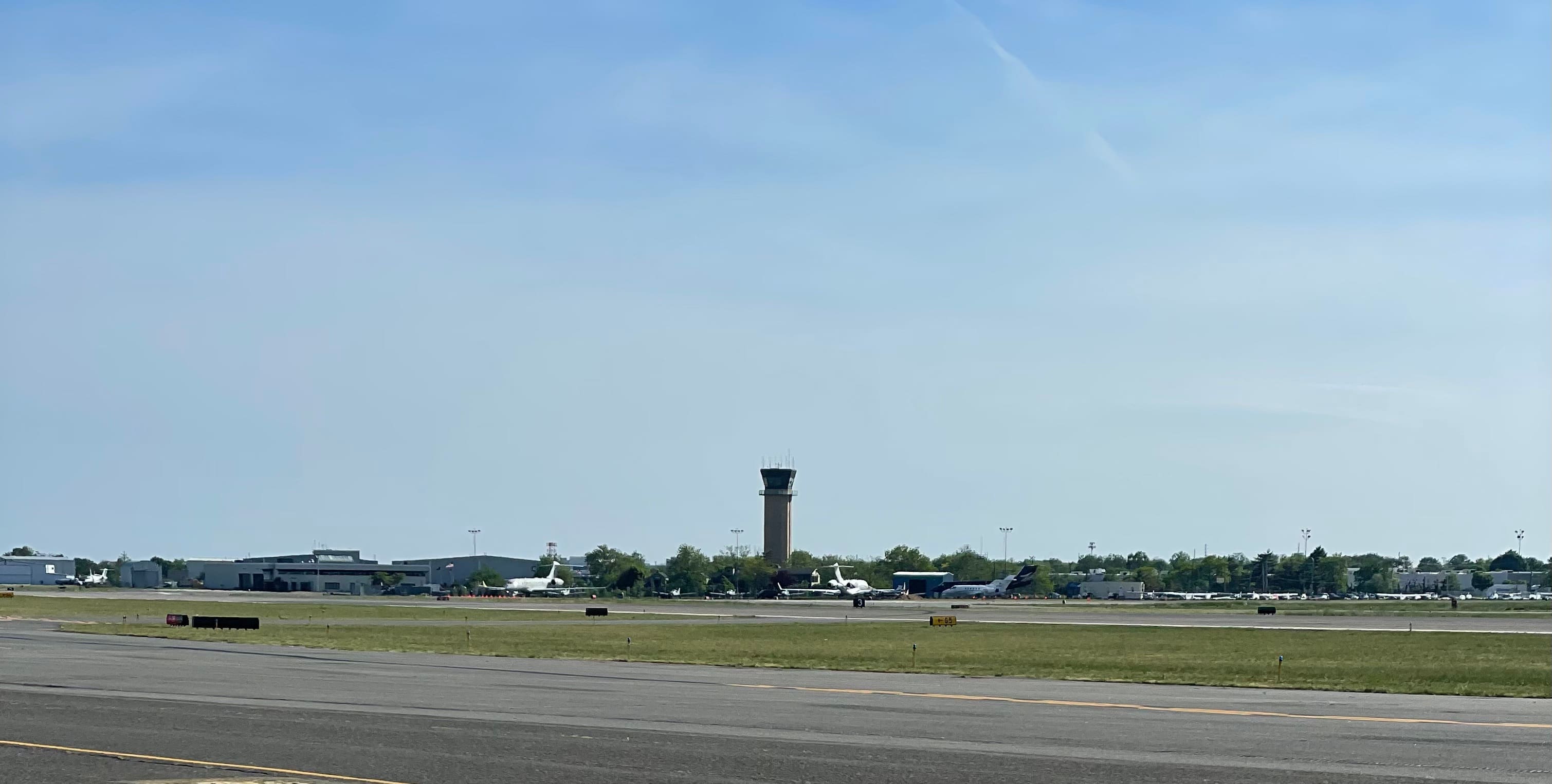
First, the field itself. Republic (KFRG) is a towered, Class D airport about an hour east of New York City, with two runways — 10/28 and 14/32 — which means a crosswind that shuts down one runway usually leaves the other open. The control tower is active, so from your first taxi you learn real radio work, sequencing, and ATC procedures in a mixed traffic environment of trainers, charter, and corporate jets. The designated practice areas sit close by, so you are not burning paid Hobbs time flying 20 minutes to get to the maneuvers area. And the location matters: it is far enough from JFK and LaGuardia's Class B that a training flight is not complicated by the busiest airspace in the country, but close enough that the whole New York metro area can reach it for an evening lesson. If you want the deeper argument for towered-airport training, we wrote a whole piece on it.
The flight schools operating at KFRG
There are a handful of schools based at Republic, and they genuinely differ. Here is the lay of the land as of 2026:
- Aspire Aviation (us). Family-owned, Part 61, flying a six-aircraft Cessna 172 fleet with modern glass panels. Discovery flights at $250. Scheduling is flexible by design — evenings and weekends, pay-as-you-go, training sequenced around your life rather than a fixed cohort calendar.
- Nassau Flyers. A Cirrus Training Center and Platinum Cirrus partner — training happens in Cirrus SR-series aircraft, and their discovery flights run $499, reflecting the platform's hourly cost. The Cirrus is a technically advanced aircraft, and their programs suit pilots who want to fly Cirrus specifically.
- Academy of Aviation. Established operation located at the main terminal side of the field, offering both Part 141 and Part 61 tracks with a fleet of trainers and an airline-career orientation.
- ATP Flight School. The national chain, with a campus at KFRG. Career-focused, structured, fast-track scheduling aimed at zero-time students heading to the airlines on a fixed timeline — a different product from a local flight school.
- Skyfarer Academy. A newer operation on the field, with $199 discovery flights — the lowest entry price at KFRG.
All of these are legitimate options. The question is which one matches how you actually live and learn.
Cessna 172 vs Cirrus: the fleet question
The biggest philosophical split at KFRG is the training aircraft. Aspire and several others train in the Cessna 172, the most-produced trainer in history. Nassau Flyers trains in the Cirrus SR-series — technically advanced, faster, with a whole-airplane parachute, and considerably more expensive per hour.
Neither is wrong. The Cirrus suits pilots who know they will own or rent a Cirrus and want their skills native to it. The 172 case is simpler: it is the standard trainer worldwide, the skills transfer to almost anything you will fly later, and the hourly cost is materially lower — which, over the 60–70 hours a private certificate actually takes, is the difference that decides whether people finish. A student who flies a 172 for two years and transitions to a Cirrus with a checkout is out less money than one who trained in the Cirrus from lesson one without needing to. If you want the full trainer-comparison argument, we wrote a piece on choosing a trainer aircraft that covers the same logic.
How to choose: the questions that matter
Forget the marketing. Ask these five questions at any school you tour:
- How big is the fleet, really? A school with two aircraft loses your training week to a scheduled maintenance or an annual inspection. A six-aircraft fleet like ours means a down airplane is a scheduling nudge, not a two-week pause. Fleet size is a direct proxy for how consistently you can fly — and consistency is the single biggest driver of your total cost and timeline.
- How is pricing structured? Pay-as-you-go means you pay per lesson and can stop anytime. Bundled packages can offer a discount but lock you in — read the refund terms before you pay for a block of hours. Neither model is a scam; just know which you are signing.
- Can you schedule around your actual life? If you work full-time, you need evening and weekend availability and an instructor who holds the same slots each week. A school that cannot protect your schedule will quietly cost you more in skill decay than any hourly rate difference.
- Who will you fly with, and how long have they been here? Instructor turnover mid-certificate costs you time and money re-establishing rapport and standards. Ask how long the average CFI has been at the school.
- Part 61 or Part 141 — and does it matter for you? Part 141's lower hour minimums mainly matter for career-track students eyeing restricted ATP eligibility. For most people, Part 61's flexibility wins. We cover the whole tradeoff in our Part 61 vs Part 141 comparison.
Where we think we win — and where we do not
Being straight about it: if you want to fly Cirrus aircraft specifically, Nassau Flyers is the better fit — that is their platform and their specialty, and we do not offer it. If you want a rigid, airline-pipeline schedule on a national curriculum, ATP is built exactly for that.
What we offer is the middle that most Long Island students actually live in: a family-owned school where you fly with people who know your name, in a six-aircraft Cessna 172 fleet that keeps you on schedule, under Part 61 with the flexibility to train around a job — and at pricing where a $250 discovery flight and a pay-as-you-go PPL do not require financing conversations you do not want. That is the whole pitch. If it fits, we would love to fly with you — you can read more about who we are and browse the full program list.
The cheapest way to decide
You do not choose a flight school from a blog post — you choose it from 45 minutes in its airplane with its instructor. Discovery flights exist for exactly this, and at KFRG they run $199–$499 depending on the school and aircraft. Fly two of them if you need to; the cost of that comparison is trivial next to the cost of choosing wrong. We put the full local price comparison in our discovery flight cost guide.
Read what flight training costs on Long Island →, explore discovery flight packages →, or ask us anything →